Shout-out to my fellow soulmates on fire 🔥 ❤️ 🖤 💛 🤍 🔥
Some orientation, for anyone who has come here from the yoga side of my life and is wondering why they are reading about software.
I have had two working lives, and they overlapped for twenty years. In one I founded and ran a social-network software company. In the other I am a yoga teacher in a Sanātana Dharma lineage — the person behind this portal, the school on it, and the books.
Most people who know me know one half. This is the document where both are written down in one place, in order, with the numbers attached — because a life kept in two separate files gets described, later, by whoever is holding the louder one.
This is a working document. It is dated the day the current specification was written, it is added to as the work proceeds, and nothing already in it is removed. It is also, in the plainest sense, a résumé — the first one I have written in twenty-five years, and the only one I intend to write.
What follows is a record of what was built, by how many people, and in what order.
The count
The whole arc in four rows — the headcount of the software business I founded, and then of everything that replaced it.
| Year | On payroll | What that number was for |
|---|---|---|
| 2005 → 2007 | 20 → 54 | the software business and its support load — offices, payroll, investment behind it |
| 2010–2011 | 54 → 10 | a pruning decision, not a collapse |
| now | 1 | all of it |
In 2008 the software business I founded and ran employed fifty-four people. Every one of them was in Kyrgyzstan, where our office stood until 2009 — a fifty-four-person software company in Bishkek, with investment behind it at a scale that changes how you sleep, building for a market that was almost entirely somewhere else.
Be exact about where that came from, because the story is usually told without it. The capital was mine. So were the years — stretches of them without a holiday and most of them without a whole night, in the same period I had small children, which meant the work and the mothering were each done at the expense of the other and both were done anyway. There is no version of that company that exists without those years. I record it because it is the part that leaves no paper trail, and things that leave no paper trail have a way of being mouthy described later as though they happened on their own.
By 2011 it was ten. Not a collapse — a decision. Ten of the most experienced engineers, and a codebase that ran better with them than it had with fifty-four staff of various skill. That number sat in my head for the next fifteen years as a kind of floor: the smallest team that could hold a full stack.
It was not the floor.
The assumption, and the file that answers it
There is an assumption that attaches itself to a woman in a technical business, so reliable you could set a watch by it: that whatever else she contributed, she was not the one doing the engineering. It has been said of me plainly, by people in a position to know better.
I am not going to reconstruct who said it, or where; that belongs somewhere else and not on this page. What matters here is that the claim is an ordinary one — it is made about women in technical businesses as a matter of routine — and that in my case there happens to be a file that answers it.
April 2003 — the thesis
I submitted a final qualification thesis in one of the unis I studied in: ninety-six pages, eighteen figures, five tables, a glossary, an English abstract. Its subject was an internet portal built to integrate many independent operators into one platform and put them onto an international market — and it does not gesture at the idea, it specifies it: the architecture section by section, the ordering and payment path, the shop, the booking layer, a costed schedule of expenditure against projected revenue, design mockups appended at the back.
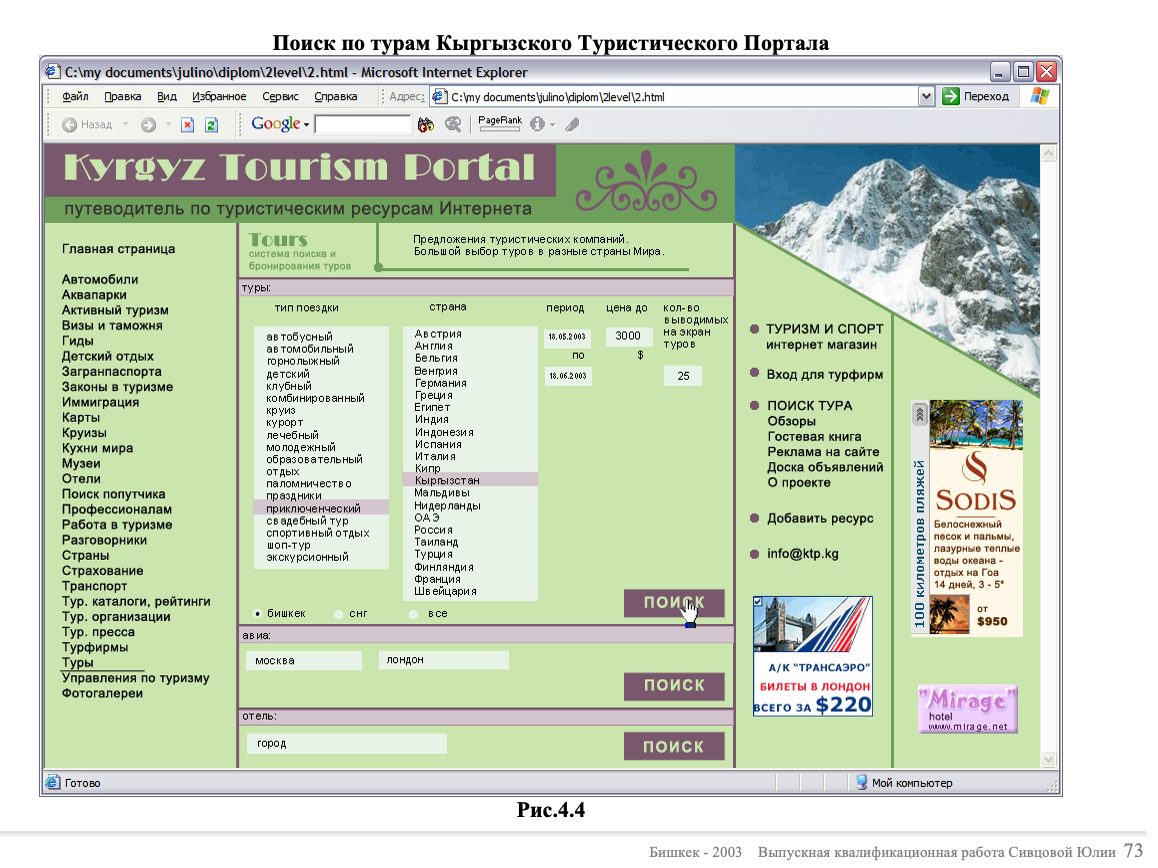
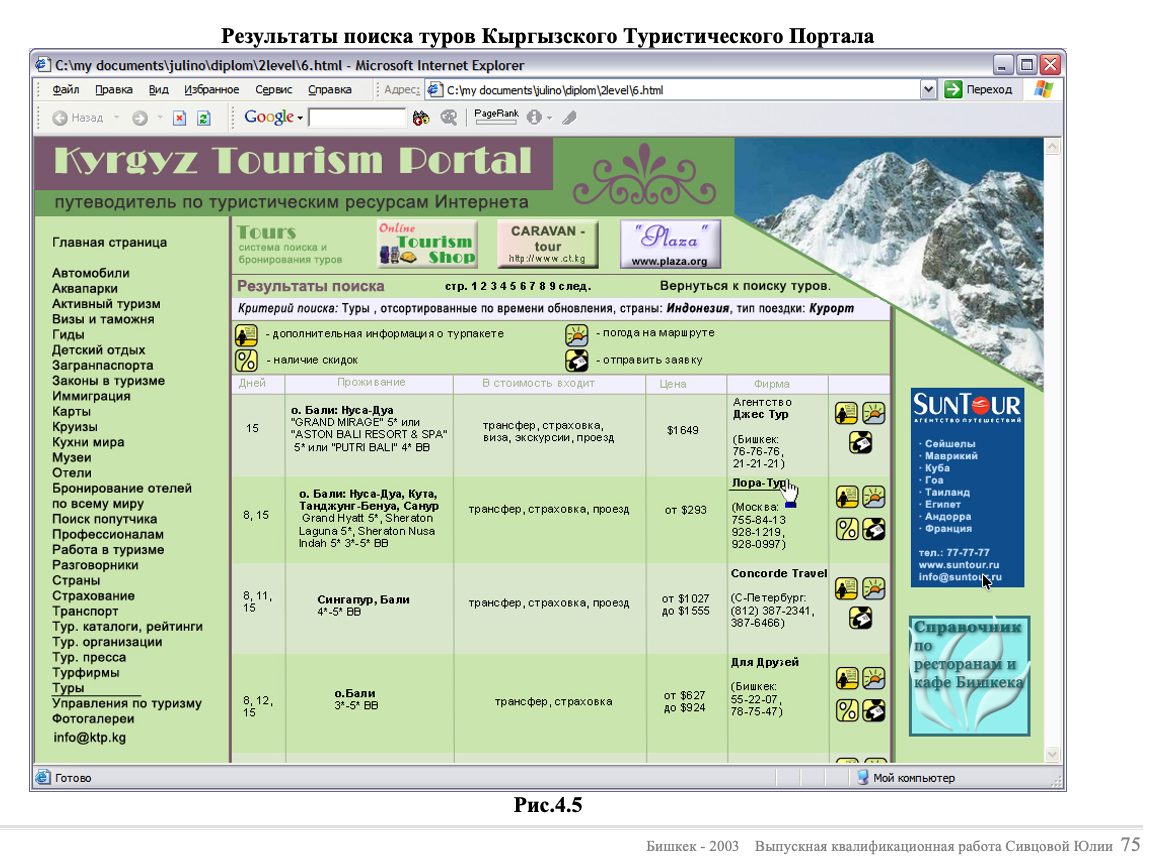
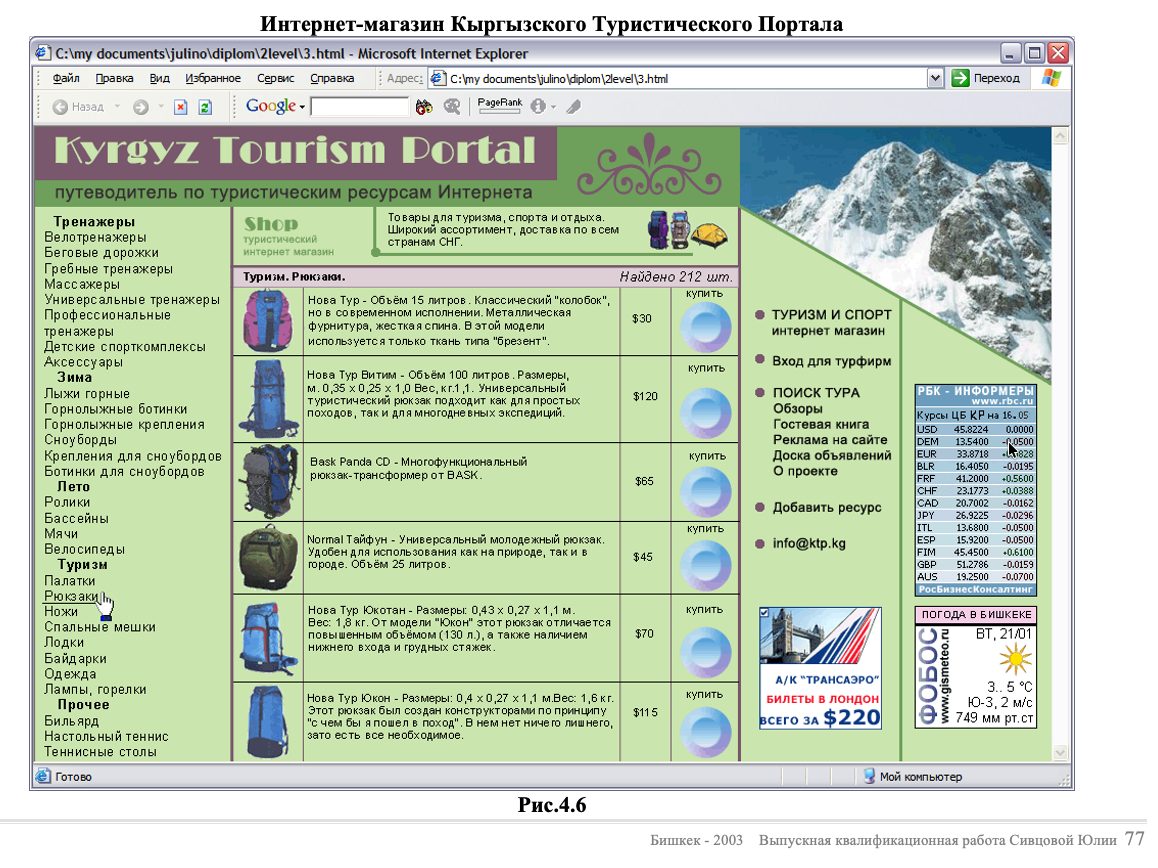
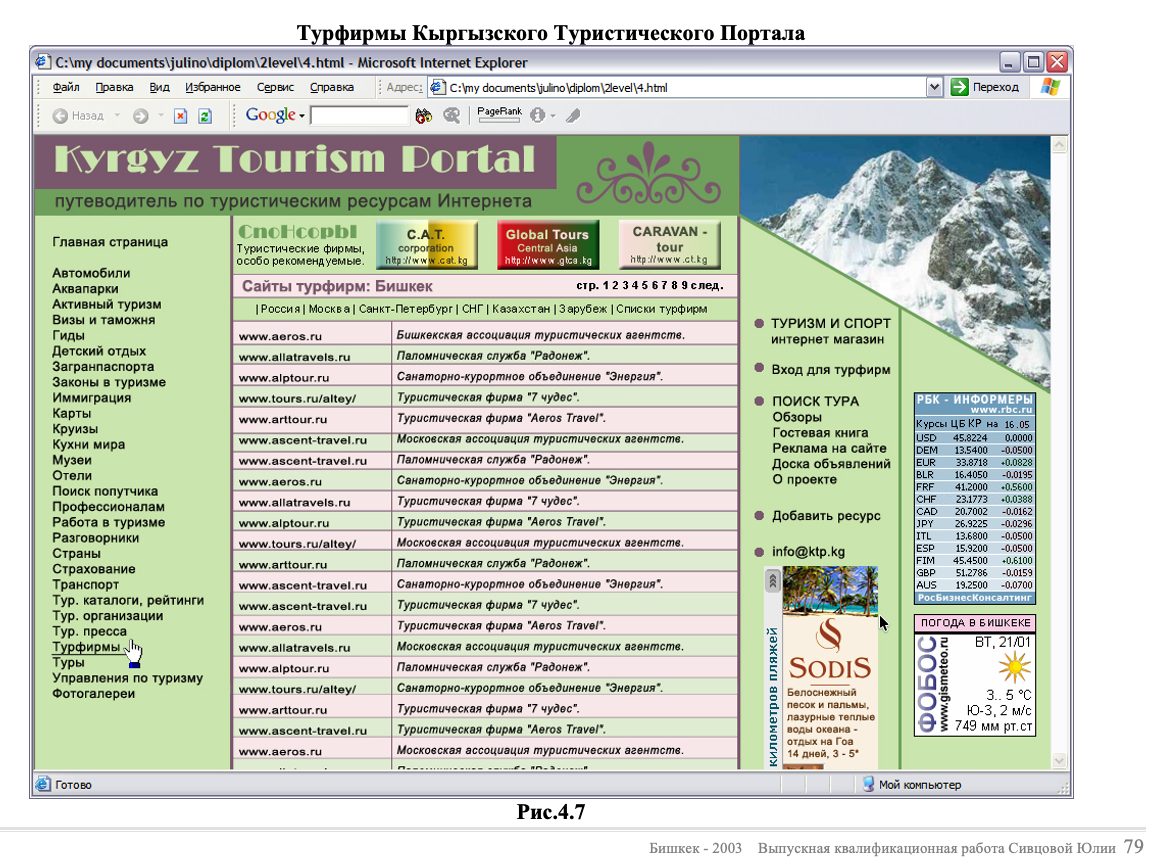
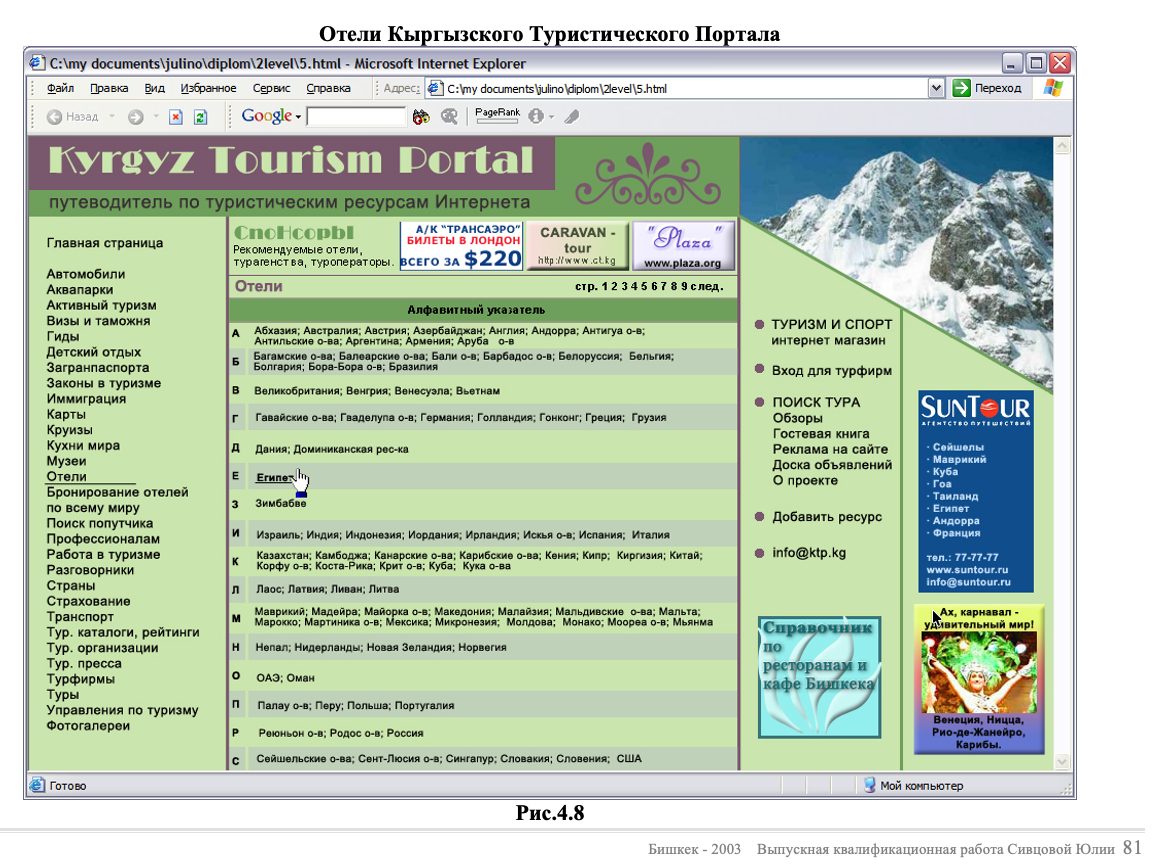
Pages from the qualification thesis, 12 April 2003 — Academy of Tourism, Bishkek. Tap to open full size.
MySpace launched that year. Facebook was still a year away. I was a management student in Bishkek writing the specification for a multi-sided platform, because the thing I could already see and could not yet build was a place where many separate operators would meet one audience.
Everything argued in this document about specification — that it is the scarce skill, that an instruction which cannot be misread by one person cannot be misread by anyone — begins in a thesis dated the twelfth of April, 2003. I did not learn it from the failures of 2023. I had it before the company became profitable, and the failures only sharpened it.
2004 — the turn
The business moved that year from making software for dating to software for social networking platforms. I will say plainly where I believe that turn came from, because this is the one document in which I get to: it came out of the portal thesis. The argument in those ninety-six pages was never really about tourism. It was about many independent parties meeting one audience inside a single system — a description of a social network, written a year before most people had the phrase.
2003 to 2009 — two businesses, one of them staffed
They ran side by side. The software business licensed the platform and carried the support load; that is what the staff were for, and by 2005 there were twenty of them. Alongside it ran a second property, which I coded and operated on my own, with no headcount whatsoever. It published content about LOVE.
The advertising statement for that second property is in front of me as I write. In 2005 it returned $89,768. In 2006, $68,860. That is AdSense alone — one channel, on one site, and not the trading income of either business. I ran the staffed company and I ran the unstaffed one, in the same years.
The one-person operation is not something I fell back on in 2026. It was already running, profitably, inside a twenty-person company, in 2005.
What I knew, and what I could not tell
One thing about that figure needs correcting before anybody assumes it, because the assumption is the wrong one. I knew it. Those statements are mine — I compiled them. I kept the numbers for twenty years.
What I lacked was the other faculty entirely, the one nobody teaches and which stays invisible until you notice it missing: the ability to tell whether a number is big or small. Ninety thousand dollars a year in AdSense from one site I made — was that good? I did not know. No peer group, no benchmark, no comparable. There was nobody in Bishkek in 2005 building what I was building to hold it against.
And here is the part that still stops me. I did have one number. I knew exactly what we paid developers, because I was the one hiring them: from 2000, between fifty and two hundred dollars a month. So the comparison was sitting on my own desk the entire time. It needed no peer group, no research, and no arithmetic worth the name.
The maths was not impressive — but not for the reason you would assume. It was not that the sum was hard. It was that I was comparing the wrong two quantities.
The software business could clear $40,000 in a month when a run of custom modification work came through. It also carried a long list of customers, a heavy support load, and twenty people servicing it — and in some months $200,000 went out of it on advertising alone.
The other site returned the figures above, and effectively all of it was profit. No staff. No support desk. No cost of sale worth the name. A woman posting love poems, and AdSense returning against them.
Set beside a business clearing forty thousand dollars in a good month, seventy or ninety thousand across a whole year looks like nothing — and that is the comparison I made, every year, without once writing it down. The comparison I never made was profit per person. Run that one even a single time and the unstaffed operation is the better business by a distance.
That is the trap, and it has nothing to do with arithmetic. A benchmark that is too big does exactly the same damage as no benchmark at all. I was not measuring my work against what one person could do. I was measuring it against what a funded company with twenty employees could do — and concluding, every year, that I was negligible.
So I recorded everything and evaluated none of it. A number you have never evaluated is not information. It is a number you happen to own.
And I am going to name the reason, because without it this reads as carelessness, and it was not carelessness. I was living through severe domestic and family violence, and I was dissociated. That is a clinical description, not a figure of speech. Dissociation does precisely what it exists to do: it takes you out of the room. You go on functioning — you keep the records, you run the business, you hold the household together — and you do not assess your own position, because assessing your own position is the one faculty the condition removes.
So I did not merely fail to count what was mine. I gave it away: my own capacity first, then my mother's resources, and when she died, what she left.
Economic abuse is the least discussed limb of coercive control and the most quietly total, because from the outside it does not look like harm. It looks like a dreamy woman. She is not bad with money. She has been taken out of the room where the money is discussed — and more often than anyone imagines, she is the one who carried it in.
Keep the numbers. Then find out what they mean — and if you cannot make yourself do the second part, that is information too.
2003 to 2005 — the directories
The working directories from those years are on this desk: PHP, Perl, templates, an admin layer, a database layer, client builds — several thousand files, every one timestamped, from precisely the period in which I am supposed to have had nothing to do with any of it.
To 2020 — the office
One operational fact that needs no archive, because it is a matter of company record: from the founding until 2020, every hire and every dismissal in that business was mine.
That is the entire rebuttal and I will not enlarge it. I do not argue with a claim like that. I file against it — and then go back to work, which is what the rest of this document is.
The other half, and where it came from
This document has been skipping something, and anyone who does not already know me will have felt the gap. There are two working lives in it, not one — and the yoga is the older of the two.
I started at fifteen: healing books first, then Transcendental Meditation. At seventeen I began Satyānanda yoga. I paid almost no attention to names and lineages and all of it to the form and the teaching. From 1996 the book I worked from was Swami Satyananda Saraswati's A Systematic Course in the Ancient Tantric Techniques of Yoga and Kriya — in Russian, and only in the pieces a translator was putting online as he finished them. I did not think of it as belonging to anybody.
Which is why, in 2009, on a personal retreat, I arrived at an ashram and worked out only once I was inside it that I was standing in the house of the lineage whose book I had been studying for thirteen years, paying no attention to the name of the author.
2009 was also the last time we travelled to Kyrgyzstan. We closed the office and moved the remaining staff to working online, which suited everyone. I kept the work and the administration; what I put down was the management of a physical building — and with it the churn, the friction and the hiring and firing at that scale.
In 2013 we moved ten hours north of Sydney, into Byron Shire, onto land — to grow organic food and live closer to the ground.
In 2018 I finished the Diploma of the Academy of Yoga Science, on top of a bachelor's degree in financial management, economics and psychology. After that I had to teach.
2018 — the lesson that cost the most
I ran an independent site on the open-source platform our own company had released. It should have been the easiest project I ever shipped. It was the hardest, and not for technical reasons: every improvement I wanted depended on developers who were fully committed elsewhere. I could specify. I could not execute. I was a founder standing in a queue behind my own product, holding a testing log of improvements nobody had time to make.
Dependence is not a resourcing problem. It is a design flaw in the arrangement. If your ability to build is held by someone whose priorities are not yours, you do not have a business. You have shackles on your feet.
2020 — what ended, and what did not
A partnership of twenty years ended — the business one and the domestic one at once, because they had always been the same one. In the same year my access to the company's systems ended with it, and I let the independent site go.
That is the whole account. It is not the interesting part.
The interesting part is what I did the following month: installed WordPress on a blog nobody had heard of and started again — on a competitor's stack. That was deliberate, and I would recommend it. Building on the thing you used to own keeps you arguing with a ghost. Building on somebody else's makes you a beginner again, which is the only condition in which you actually learn a second system.
One correction belongs here, because the assumption runs the wrong way, and it runs that way about every woman who stops being visible in a business she built. I did not resign, and I have not. I remain a director of the company I co-founded. Neither the office nor the shareholding was ever given up.
By 2024 those two things were all of it still in my hands. That was the year I went into the market and found buyers, from a standing start, with nothing behind me. I brought term sheets to the table valuing my half at seven million dollars. The exit did not happen.
I record it because this is the only place that is kept straight, and because she could not have sold it anyway is the assumption that attaches itself, unspoken, to a woman in that position. I could have sold it. I had the papers — sourced in the same period I was building this portal, which should tell you which of the two was harder.
My position today is what it was then, stated plainly and without heat: I am open to a fair exchange for my half, on ordinary commercial terms. No expiry date on it. Not a grievance — business, and I am still a director. Beyond that I will say nothing here: some of it is company affairs and I hold an office, and the rest is not for a page.
But I am not waiting on it. I am busy rebuilding myself and building up others, and the rest of this document is what that has looked like.
Parallel ledger — the teaching, 2018 to 2025
The software was never the only thing being built. From 2018 I taught from the property where I lived — not a studio hired by the hour but a hall on the land, the practice and the fire and the people in one place. In 2017 my teacher, Swami Satyadharma Saraswati, put a copper kalaśa into my hands and told me it was for a yoga shala I did not yet have. The foundation stone for Śrī Kailāshpati Mandir went down in June 2021; the walls were mud — subsoil, sand, straw, water, hands. It was consecrated on Mahāśivarātri, 1 March 2022, at half past midnight, two-weeks-postpartum, with a two-week baby on-breast, with post-partum haemorrhoid and active mastitis at 40 degree fever. During the "flood of 2022", where our property turned into a lake, with mud all over the temple floor, with no electricity for five days.
I was teaching also on the night of delivery of my baby, and was running the scheduled event the next day — with a night in between to deliver the baby. Nothing was moved.
The oldest article in this archive is dated 9 June 2021, and it is the announcement of that foundation stone. It was not written here — this address did not exist yet. ecology.yoga was registered in 2023, and everything already written came across onto it, dates intact, from the blog it had been living on.
The mandir has since been consumed by the fires of life. In November 2025, after twelve years, I was forced to leave the land. So that piece stays exactly where it is, because it has now outlived two things: the platform it was published on, and the building it announced.
Sit with that list, because the pattern in it took me too long to see. A company. A temple. A house. Every item shares one property: it could be held. A company has a share register, a building has a title, a house has a name on a lease — and anything with a name on a document can have the name changed. That is what a document is for.
So I moved the work to what cannot be held.
An article that has been read is in the reader. A curriculum given to a student is in the student. A Sanskrit word put back into a mouth is in the mouth. A specification is in the head that wrote it; a skill is in the hands that learned it. There is no instrument in law or in commerce that assigns any of them to somebody else — which makes them a category of asset with one unusual property: they survive the loss of everything standing around them.
There is a second column in that ledger, and it does not contain buildings. I am not going to itemise it, and the reason is the whole of my position: I will not spend my children's privacy to add colours. It is by a long way the heavier column. It stays closed. Anyone who has carried one will recognise the shape of it from the outside, and nobody else needs to.
Two notes for anyone in the middle of one
The only advisory passage in this document. Both notes took me years to learn and about ten seconds to write down, which is the usual ratio.
One. When a partnership of that length comes apart inside a company, people have to choose — and almost none of them are choosing between two human beings. They are choosing where the payroll is, where the equity sits, and which side of the room holds the keys. Some were friends long before they were colleagues, which is what makes it feel personal. It generally is not. I lost a great many people in a very short time and spent an unproductive year working out what I had done to deserve it. The answer was nothing. Proximity is not loyalty; an organisation is a gravitational field, not a friendship. Grieve that once, properly, and refuse to spend a second year on it — the second year is the expensive one, and nobody is coming to reimburse you for it.
Two, and this one is nearly free. If a person tells you what they intend to do to you, believe them. It is not a warning and it is not bluster. It is a description, offered by somebody who has not yet worked out that describing it is the single most useful thing they will ever do for you. Write it down. Date it. Keep it somewhere that is not in the building. Then go and build, at speed, in the places it cannot reach — because you have just been handed the map, and the person who handed it to you does not know that they have.
I did both. The record of the second is not on this page and never will be. The record of the first is everything below this line.
2023 to 2025 — what outsourcing actually buys
For three years I did what every founder without capital does: I bought the work in pieces, from wherever the pieces were cheapest, across four continents and a dozen contracts.
Be precise about the result, because the lazy version of this story is a complaint about contractors and it would be both untrue and beneath the subject. Every round delivered something real. It simply was not code.
What it delivered was specification. Each failed handover taught me exactly which of my instructions had been ambiguous. By the fourth round I was writing requirements that could not be misread, because I had watched every possible misreading arrive as a deliverable. The document dated 4 August 2024 — eighteen numbered demands, a three-column layout defined section by section, split payments, nested categories, ranks, a launch date of 12 September and the sentence "everything must work like a clock" — is the direct product of everything that failed before it. It is the best thing I wrote in that period, and I wrote it for other people to execute.

One developer in that stretch was genuinely excellent. I could not afford to keep him. There is no grievance in that sentence in either direction — it is the arithmetic of building while everything else in your life is on fire. When the money ran out the work stopped, and I was left holding a very good specification and no one to give it to.
On dependencies, and why this stack looks the way it does
Since 2021 I have spent thousands of dollars on this platform — licences, add-ons, renewals, other people's labour. I do not have that money now. And the thing I actually bought with it was not a stack. It was an education in dependency.
A site of this kind is assembled out of other people's software: one plugin for the school, one for the membership, one for the shop, one for the mail — each from a different vendor, on its own release cycle, with its own annual renewal, and every one free to change what it does or stop doing it. Each is sold as independence: your own software, downloadable, yours. Assembled together they are the opposite. They are a soup, and when it curdles there is nobody whose job it is to care.
I am unusually well placed to say what a lifetime support promise is worth, because I used to be on the side that made them. I know what goes into writing that sentence on a sales page, and what it is worth to a customer once the company that wrote it changes shape. So when a vendor tells me a licence is perpetual, I hear it in my own voice, from twenty years ago.
Which is the lesson of 2018 again, one layer down. It makes no difference whether the party you depend on is a developer, a partner, or a company with a support portal.
The question is never are they trustworthy. The question is what happens to me if they are not — and if the answer is "everything stops", the architecture is wrong no matter how good they are.
The tradition has a name for what cannot be forecast: bhūta-preta, the restless spirit, the thing that arrives on no schedule. And it makes a point it took me twenty years to learn — proximity to strength is not protection. Being formidable yourself does not make you safe from it. Nothing does. Which is why the correct response is not vigilance, and it is certainly not better judgement about people. It is architecture.
So the stack looks the way it looks on purpose. matri.au is hand-written HTML, CSS and JavaScript in version control, with no dependency anybody can revoke. Everything that can be written down is written down, in one place, in one format, so that any part could be rebuilt by somebody who was not there when it was made. That is not minimalism as a taste. It is the only architecture I trust, and not because it is elegant — because it does not require me to trust anybody.
2026 — one
So I built it.
Not "managed the build". Wrote it. On a normal org chart the work below this line is filled by eleven people — solutions architect, back-end, front-end, database, QA, data migration, editor-in-chief, curriculum designer, production designer, audio producer, publisher. There is one of me. I am an educator by vocation, and I spent twenty years as the business brain standing behind engineers rather than being one. Both facts were supposed to be disqualifying.
The rebuild is not a website. It is a publishing system, a school, a membership and commerce layer, and a searchable archive — five properties across three separate stacks: this portal on WordPress and PHP, with its plugin layer, its theme and its integrations; matri.au, written by hand in simple static HTML, CSS and JavaScript; two further sites on a third toolchain; and the fifth still in progress. Every one under version control, with the commit history to show for it.
Three separate disciplines, and nobody hands a single operator all three. You acquire them one emergency at a time.
Some of what that has meant
- A complete learning-management migration — carried from one platform to another without losing a student record or a single authored question.
- A membership and commerce layer over a catalogue, including the payment integration and the plan structure behind it.
- A written editorial standard, against which every piece published here, and that nothing is published without clearing it.
- A publication schedule banked and dated into November 2027, so the work is planned ahead.
- Performance and delivery work — the unglamorous half of a fast site, and the half that rewards measurement over opinion.
- A publishing pipeline carrying a manuscript through to a printed specification, audiobooks, and distribution.
None of it is exotic. All of it is ordinary professional work — and that is the point. Ordinary professional work in eleven disciplines, held by one person, to a deadline.
The part that made one person sufficient
It is not mysterious, and it is the one part of this worth passing on.
First, the specification — three years of failed handovers had already forced me to write instructions that could not be misread. Second, removing the wait — the constraint of 2018 was never skill, it was queueing behind other people's priorities; take the wait out and a specification becomes a build. Third, and least discussed, the record — every change written down, with numbers, before and after. That is what makes a one-person operation auditable rather than a private mess, and it is the part everyone skips, because it is the only part with no visible output.
The order matters. Nobody hands you the third part. You earn it by being failed enough times to understand why it is necessary.
What it stands at today
| Library | School | Craft | matri.app stack |
|---|---|---|---|
| 369 articles | 19 courses | 5 properties, 3 stacks | TypeScript, React Native, Expo |
| 1,358 subject tags | 540 lessons | 772-term Sanskrit glossary just for that | React, tRPC, Zod |
| 38 nested categories | 51 assessments | publications scheduled to Nov 2027 | PostgreSQL, Drizzle ORM |
| 1,840 media items | 36 assignments | 264 catalogue items | Node.js, Docker |
| 50 static pages | 676 authored questions | 1 published book, 3 behind it | pnpm |
Fifteen months of publication banked and dated. Nothing in that table is a projection; every figure was read from the live systems on the day it was written down.
The stack behind matri.app, plainly: TypeScript, React Native, Expo, React, tRPC, Zod, PostgreSQL, Drizzle ORM, Node.js, Docker, Turborepo, pnpm.

There is a second system in build. I am not going to describe it until it is live.
What none of it is
A stack is scaffolding. It is not the thing.
The body of knowledge taught here does not organise itself, and no system organises it either. It has to be held — held in one place with something like a forged-steel grip, and turned slowly on its own axis until it settles, clarifies, and gives up its essence. That grip is not software and cannot be bought, installed, subscribed to or delegated. It is twenty-five years of practice, a teacher who put a kalaśa in my hands, and a lineage standing behind both.
Everything in this document exists to carry that and to keep it safe. It is the load. The rest is the vessel.
The press
A publishing arm was not in the 2024 specification. It exists because the teaching needed a form that travels without a server, and because a book is another thing that cannot be held by anybody but its reader.
THE SPINE is finished and out: eighteen chapters in two movements, ascent and return, written from the ground up as spoken word rather than adapted from a page — roughly five hours of it — released as a book and as audio. It has since been translated in full into Russian, where a cognate English cannot carry closes the last line of the last chapter on the same root the book opens with. That is not a translation note. It is why the Russian edition is the better one, and I say so as its author.
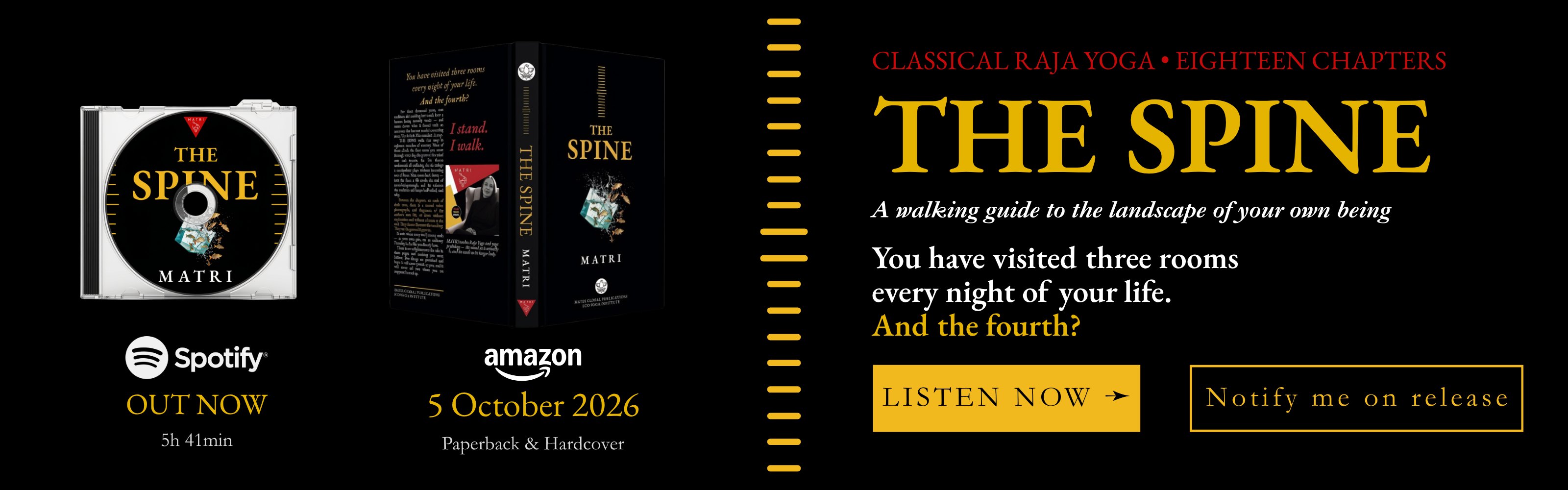
Behind it, in order: a novel, a series written at a forensic level history detective, and a deep yoga woven into it. They belong to one series, MYST · MEGHA · MYTH. I will not describe those until they are in a launch-phase — but the first one is done, and it is the proof that the rest is following.

The name on the work
For twenty years I stood behind other people's names.
I designed the processes and let them be introduced as somebody else's. I ran the operation and put the visionary out in front of it. I did it because I believed the work mattered more than the credit, and because I had absorbed, in the way women in technical businesses absorb it, that this was maturity.
It is not maturity. It is an accounting error, and it compounds quietly for decades. Credit is not decoration laid over work — it is the record of who is able to do the work, and that record is the one thing still standing after everything with a title on it is gone. Twenty years of keeping my name deliberately off things is the exact reason those years now have to be reconstructed from documents, in a post like this one.
I am not doing it again. Not from vanity — from arithmetic. An unrecorded contribution is indistinguishable, afterwards, from one that was never made.
So the portal carries my name: it is the MATRI eco-yoga portal. matri.au is up. What I do is published as mine, on the day I do it, with the numbers attached and checkable by anyone who cares to.
The two run in parallel and they do different work. ecology.yoga is the portal — the library, the school, the community, the shop — and it carries Facebook and Instagram alongside it. matri.au is the teaching, under my own name. Both have a channel on YouTube. Very little is duplicated between them, because they are not the same thing: one is the house, the other is the person who teaches in it.
I founded the company. I laid the temple. I built the portal. I am rebuilding the stack.
I am enough. And, ENOUGH.
A note on hungry ghosts
One passage here is not about engineering, and it earns its place.
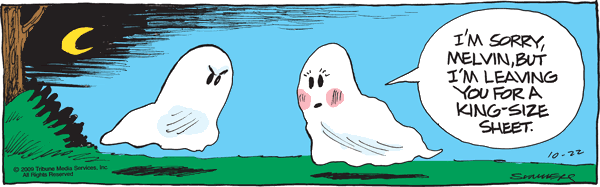
The tradition has a precise word for a particular condition: preta — literally the departed. In both the Hindu and the Buddhist accounts it is drawn the same way: an enormous distended belly, mouthy mouth and a throat no wider than a needle. The Pali canon gives them a whole book, the Petavatthu — fifty-one verse stories, each tracing how a particular ghost came to be one; the Garuḍa Purāṇa gives the condition its own section.
What the texts describe is not a monster. It is an appetite that has outgrown any possible satisfaction — a capacity to take that has consumed the capacity to receive. The horror is not the hunger. It is the needle throat: the thing starves in the middle of a feast, and the obstruction is its own.
Anyone who has been in business long enough has met the condition. Naming it once, without heat, saves years: it cannot be satisfied, because satisfaction is not the mechanism; it cannot be reasoned with, because it is not an argument; and it cannot be outbid. The damage is not what goes — it is the years spent assuming that enough would eventually be enough.
The tradition is also unusually practical about the remedy, and this is the part almost nobody quotes. A preta cannot eat what is handed to it. It can receive only what is given away in its name to somebody else. Merit transferred, not food offered. The one thing that reaches it is a gift it never touches.
I did not set out to demonstrate that. But a library anyone can read for nothing, a curriculum given to students, a body of Sanskrit put back into circulation — that is a structure which cannot be consumed. It can only be given away. It has no resale value and nothing in it to hold over anyone, and that is not a weakness in the design. It is the design.
The coda, which is the only interesting part
Everything with a name on a document went one way. I went the other. And the assumption underneath — an ordinary one, made every day in boardrooms and in kitchens — was that the thing worth having was the infrastructure. The share register. The codebase. The building. The list.
It was never the infrastructure.
The tradition has an older word for what is actually being reached for in an arrangement like that. Śakti — power, capacity, the force by which anything works at all. And it is exact about how that moves: it can be given, and there is a precise word for the transmission — śaktipāta, the descent of power from one who has it to one who is ready. What there is no rite for anywhere, in any lineage, is taking it. Not because taking is forbidden. Because it is not that kind of thing. Everything built on the assumption that it can be extracted ends in the same place: holding the vessel, wondering where the water went.
Capability does not appear on a balance sheet, cannot be assigned by any instrument, and walks out of the building inside the person who has it.
Which is available to anybody reading this who is currently being given to understand that they are the replaceable half of an arrangement. You are not the assets. You are the thing that made the assets work — and unlike them, you leave when you leave.
So let me be exact about the outcome, in the flat language of a balance sheet, since that is the language the question was asked in. Everything that could be held, went. Everything that could not be held, stayed — and the second column turned out to be the productive one. I am still here. I am still a director. I built every item in the table above after the fact, and I am not finished.
A hungry ghost cannot eat capability. So it is still hungry. That has not been my problem for some time.
Build the thing that cannot be eaten. It is the only asset a hungry ghost has never once been able to hold.

Faithfully Yours,
Matri
YouTube: @MatriTalks
How this document works
The entries above are closed. Everything that follows will be appended below this line with its date, and nothing above it will be edited to look better in hindsight. Where a number changes, the new number goes in with the date it changed, and the old one stays.
Fifty-four, then ten, then one. I am not proposing that one is better. I am recording that it was possible — on a specific stack, in a specific year, by a person with none of the usual advantages — and that the count of people was never what held the thing up.